K-pop system a 'North Star' for global industry, mogul says at MU:CON
K-pop, despite the “K” in its name, has long outgrown its local roots to become a global production network — one so efficient that it can churn out a complete song in a single day.
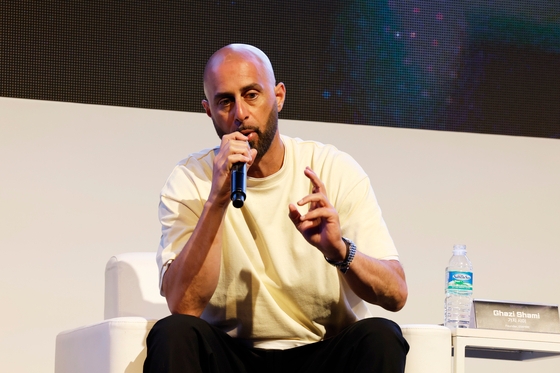
And that hyper-structured system could serve as a “North Star,” says Ghazi Shami, a U.S. industry mogul who founded Empire Distribution.
“Things that come out of Korea tend to be very exceptional,” said Shami in his keynote remarks during MU:CON, Korea’s largest annual music industry get-together, which kicked off its four-day run in central Seoul on Wednesday.
“The K-pop market is really interesting to me because of the elite level of songwriting,” the CEO noted, pointing to K-pop’s entire production pipeline from the upstream of songwriting and engineering to the downstream of marketing plans, touring and merchandising.
“Oftentimes, we point to that to our U.S. artists as a 'North Star' for what's possible if you really commit to your crowd,” he added.
The globalization of K-pop, not merely as cultural content but as a systemized industry, took central stage at this year’s MU:CON, organized by the Ministry of Culture, Sports and Tourism and the Korea Creative Content Agency.
The four-day event features keynote speeches, conferences and networking opportunities for industry professionals, as well as global music showcases open to the public.
Shami, one of the two keynote speakers for the Wednesday session, founded San Francisco-based indie label Empire in 2010, which signed artists like Kendrick Lamar, Snoop Dogg, Cardi B and G-Dragon. Empire partnered with the K-pop superstar last year, the first K-pop artist to sign with the label, who Shami described as “a mega star.”
“What's exciting for me here is taking something that's extremely polished and giving it a little more edge [by] combining the way we do things in the U.S.,” said Shami, on Empire’s plan for how it would approach the K-pop market as a publisher.
Choi Jin-suk, global A&R executive of Kreation Music Rights under SM Entertainment, spotlighted how K-pop’s production system itself has evolved into a global network in his keynote speech that followed.
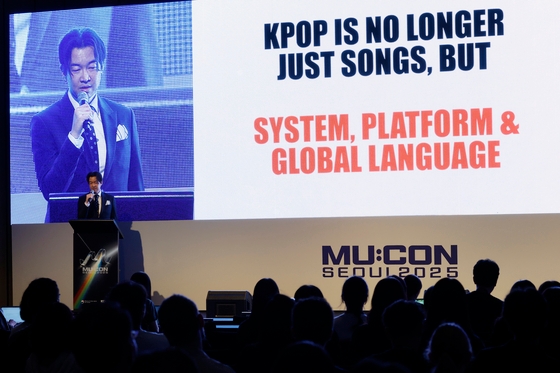
While acts like BTS or Blackpink delivering slick performances onstage may be the first things that come to mind, Choi stressed that such an image is only the tip of an iceberg that has evolved into a hyper-systemized, international hit machine.
“As K-pop expands its foothold, many smaller publishers are coming to Korea, seeking a partnership with Korea’s publishers and entertainment companies,” said Choi. “This means that K-pop is exporting not only its songs, but also its industrial structure and system.”
Choi pointed to international song camps, highly systematized song-writing sessions where producers and songwriters worldwide collaborate under a division-of-labor model to generate tracks at scale, as what powers the industry's unique efficiency.
“In earlier days, the usual practice was to complete one demo track in two days during a song camp,” Choi said. “But with upgraded systems, tools and pace, the standard now is to complete a song in a single day.”
Korea, therefore, is emerging as a hub that brings in global talent across the globe, Choi said.
“K-pop’s success does not belong only to artists onstage — it’s a result of joint efforts by songwriters, producers, publishers and a global collaborative system that enabled it all,” the executive said. “What we have built may have already established itself as a new grammar for the global music industry to become a system, a platform, that transcends music itself.”
BY SHIN HA-NEE [shin.hanee@joongang.co.kr]