With BTS's comeback, the public and private sectors came together to pull it off
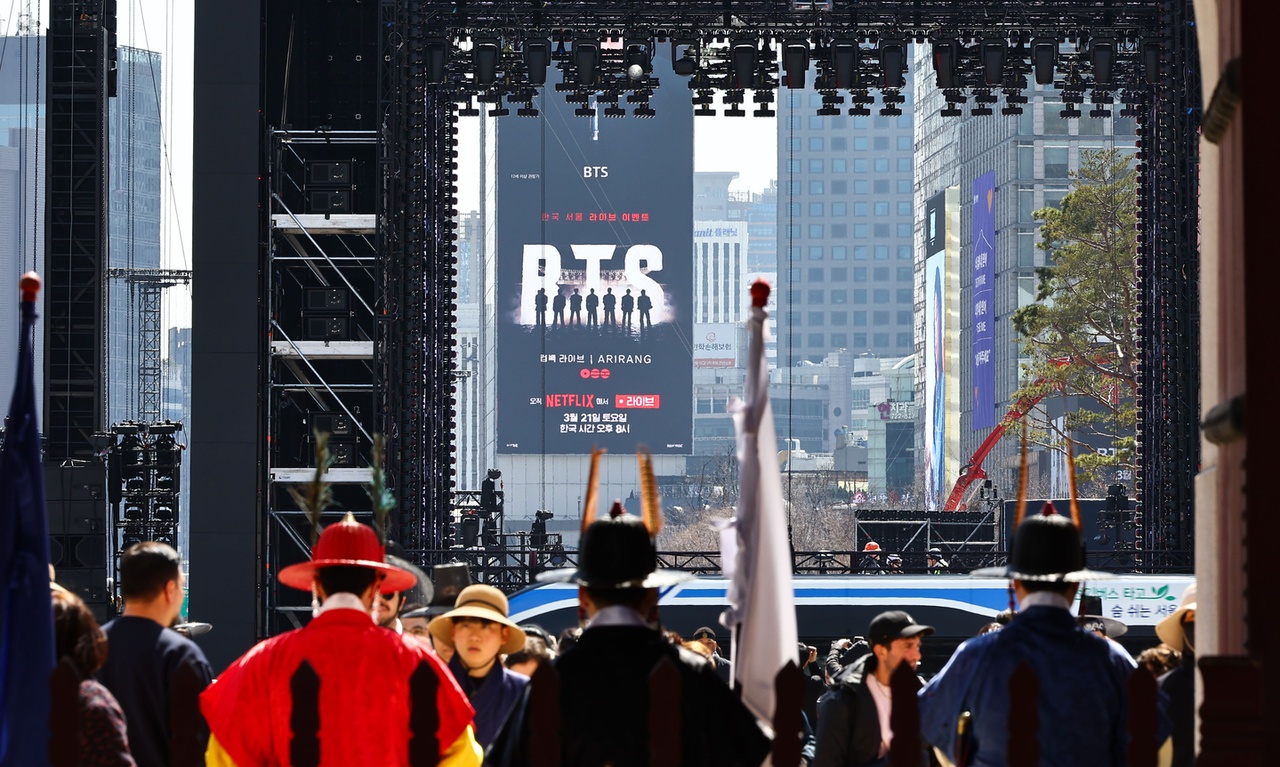
Is BTS merely a K-pop boy band that soared to global fame? Korea’s massive deployment of personnel and public resources for its concert on Saturday suggests otherwise — pointing to the group’s status as a de facto national asset.
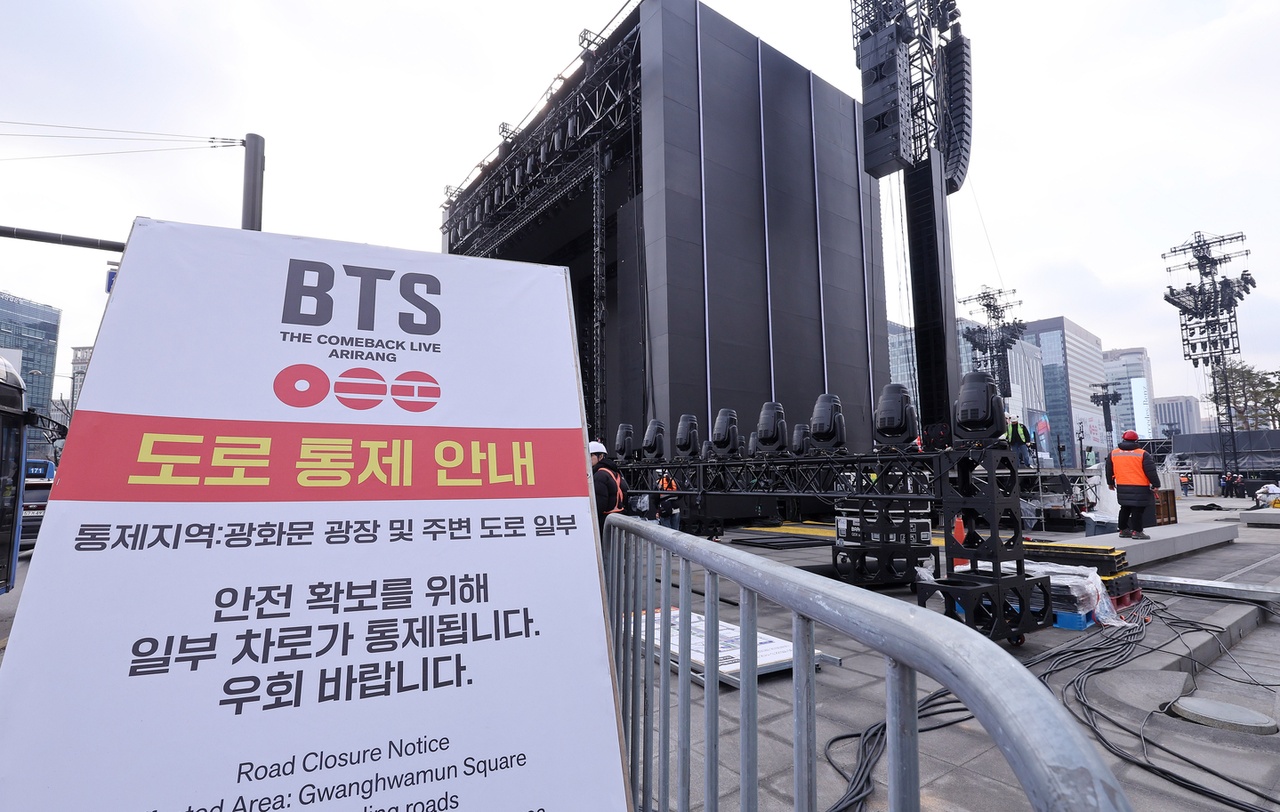
A total of 6,500 police officers, 31 temporary gates, 5,400 pieces of equipment, including aerial surveillance vehicles, 99 fire engines and ambulances and 2,399 portable toilets are mobilized for the concert in Gwanghwamun Square in central Seoul.
Police estimate a crowd of up to 260,000 people for the event, including some 34,000 seated inside the venue and crowds expected to watch from outside.
The safety crackdown extends beyond the police, affecting related businesses and nearby historic landmarks as well. The Korea Heritage Service conducted multiple reviews to permit the use of nearby heritage sites such as Gyeongbok Palace and Namdaemun and decided to close the palace and the National Palace Museum of Korea on the day of the concert.
The National Fire Agency launched emergency safety inspections of accommodations across Seoul. The Seoul Metropolitan Government convened a regional festival subcommittee to review safety management plans, while also cracking down on 18 lodging businesses accused of overcharging.
One reason a broad public consensus has formed around these coordinated measures was the expectation that the concert, which is free of charge, will benefit the national interest. The performance will be livestreamed via Netflix to more than 190 regions, offering a global showcase of landmarks such as Gwanghwamun, Namdaemun and Gyeongbok Palace.
“BTS has promoted Korean heritage in diverse ways, producing positive outcomes by reshaping the country’s brand image,” Hong Seok-kyeong, a communications professor at Seoul National University and author of “BTS on the Road” (2020), said. “There appears to be a shared societal belief that this concert will also contribute to national interests.”
Koo Jeong-woo, a sociology professor at Sungkyunkwan University, said the Gwanghwamun concert can also be seen as “a form of reciprocation for BTS’s contributions to enhancing national prestige, such as its performance supporting Busan’s bid to host the World Expo [in 2022].”
BTS’s enormous influence on the broader entertainment economy is also hard to ignore. Concerts by global pop stars like Taylor Swift and Beyoncé are often described as an economic windfall for host cities, boosting local lodging, consumption and tourism.
The same is happening with BTS. Commercial districts across Seoul are already seeing increased activity. Fashion brands such as Hazzys and Kolon Sport have decorated flagship stores in Myeongdong in central Seoul in the band's signature purple and are running promotions targeting global fans.
Starbucks is introducing two Seoul-themed beverages, including a makgeolli-flavored (Korean rice wine) cold brew, at 100 tourist-area stores such as those in Myeongdong and Gwanghwamun to attract foreign customers.
The Korea Tourism Organization said the number of foreign visitors to Korea reached a record 18.7 million last year and is expected to surpass 20 million this year — raising expectations for so-called “BTSnomics,” a portmanteau of the band’s name and “economics.”
Industry insiders also predict that BTS’s comeback could further elevate the global standing of K-pop. In the past, boy bands were often seen as constrained by mandatory military service, which created a roughly two-year hiatus and limited their ability to transcend the fast-changing nature of trend-driven industries.

“If BTS successfully completes this comeback, K-pop could establish itself as a long-term intellectual property industry,” a representative of a major entertainment agency who requested anonymity said.
Brokerages have also raised their targets for HYBE, estimating that the band’s upcoming world tour — scheduled to begin in Korea on April 9 and run through the first quarter of next year with 79 shows — could generate between 1.2 trillion won and 1.6 trillion won in revenue ($801 million and $1.07 billion). The upper estimate is comparable to this year’s budget of the Ministry of Gender Equality and Family, which stands at 1.99 trillion won.
IBK Securities projected album sales of 6 million copies, tour attendance of 6 million, an average ticket price of 300,000 won and average merchandise spending of 140,000 won, forecasting total revenue of 2.9 trillion won from BTS’s latest album “Arirang.”
However, concerns remain over the use of public assets — including cultural heritage sites and government resources — by private companies such as HYBE and Netflix.
“Strictly speaking, this is a comeback concert for a specific artist,” critic Jung Min-jae wrote on social media. “If such large-scale events that effectively paralyze city functions are allowed, what criteria will Seoul use to approve or reject similar requests from other artists or agencies?”
Safety risks also cannot be ruled out, given the expected crowd size.
“Authorities must thoroughly examine potential risk factors for crowd crush incidents in advance when large numbers gather suddenly,” Kong Ha-sung, a professor of fire and disaster prevention at Woosuk University, said. “Measures such as installing fences and deploying personnel are needed to prevent access to hazardous structures like ventilation shafts.”
This article was originally written in Korean and translated by a bilingual reporter with the help of generative AI tools. It was then edited by a native English-speaking editor. All AI-assisted translations are reviewed and refined by our newsroom.
BY CHOI MIN-JI [shin.minhee@joongang.co.kr]