K-pop misses Grammy big game categories, but hunts down first win
K-pop once again fell short in the Grammy Awards’ top categories — but this time, it still walked away with history.
At the 68th edition of the ceremony, held Sunday evening at the Crypto.com Arena in Los Angeles, singer Rosé’s “APT.” (2024) was nominated for three categories — Record of the Year, Song of the Year and Best Pop Duo/Group Performance — but did not win. Katseye also failed to secure awards despite nominations for Best New Artist and Best Pop Duo/Group Performance.
The Tony Award–winning musical “Maybe Happy Ending” nominated for Best Musical Theater Album similarly failed to take home the prize.
“Golden” (2025), featured on the soundtrack of Netflix’s hit film “KPop Demon Hunters” (2025), did not win in three additional categories, including Song of the Year, Best Pop Duo/Group Performance and Best Remix Recording. The film’s soundtrack was also up for Best Compilation Soundtrack for Visual Media, only to leave empty-handed.

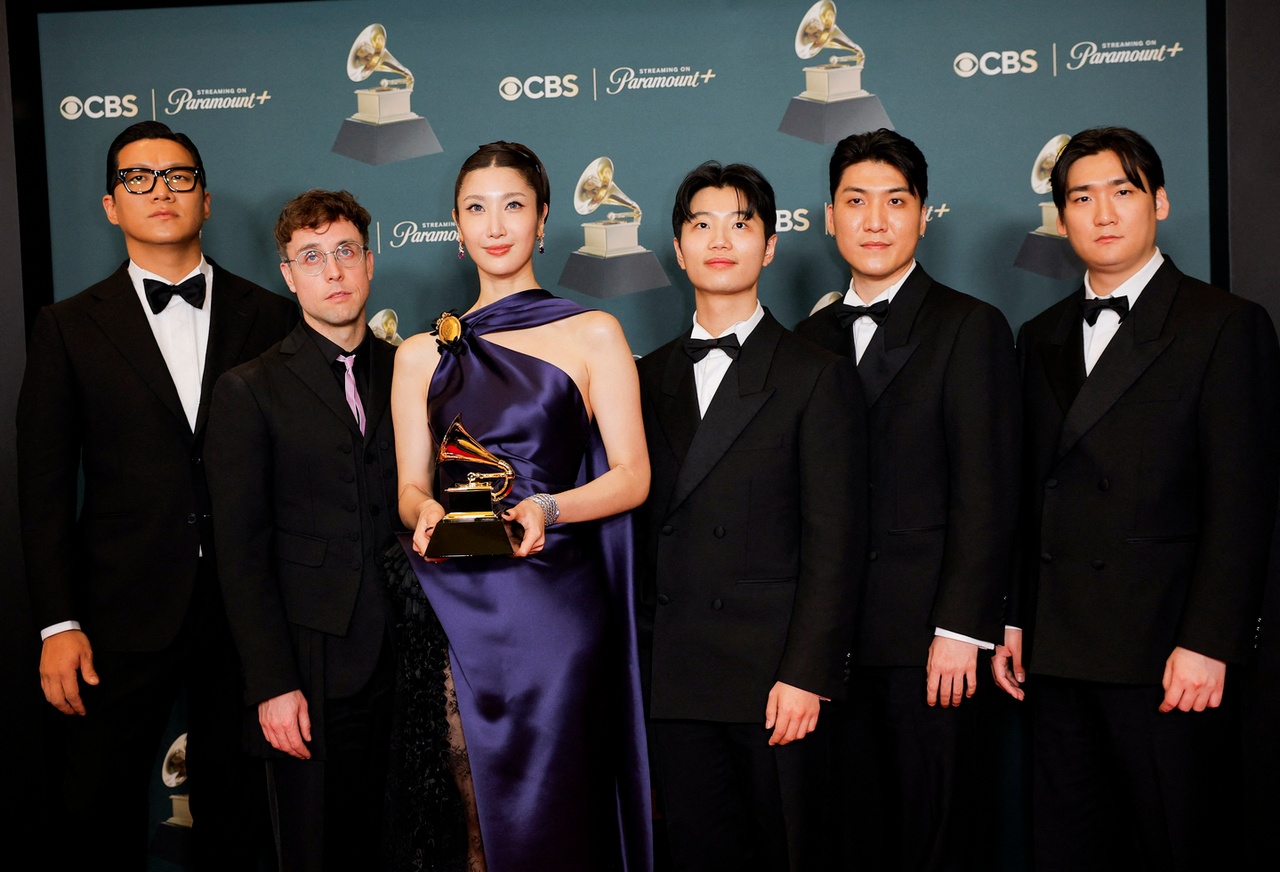
Despite disappointing results in the Grammys’ main categories, the night was not without a silver lining that turned gold — “Golden” won K-pop’s first-ever Grammy trophy.
The song won Best Song Written for Visual Media, an award given to the song’s composers and lyricists. The win makes Korean American singer-songwriter EJAE, who wrote and performed the song, a Grammy winner along with co-composers Teddy, Lee Yu-han, Kwak Joong-gyu, Nam Hee-dong, Seo Jeong-hoon and Mark Sonnenblick.
Co-songwriters and co-performers Audrey Nuna and Rei Ami were also named recipients.
In his acceptance speech, Seo, known under the moniker 24, said that he dedicates the honor to Teddy — the chief producer for The Black Label, which manages artists like Rosé, Jeon Somi, Allday Project and Meovv.
While Korean artists have previously won Grammys in classical categories — including soprano Sumi Jo in 1993 and violist Richard Yongjae O’Neill in 2021 — no K-pop act had taken home a Grammy trophy. Even BTS, which was nominated for Best Pop Duo/Group Performance for three consecutive years from 2021 to 2023, fell short of a win.

Observers say the award signals a shift in how K-pop is perceived, long dismissed as a niche or subcultural genre in Western music circles. Regarding “Golden,” the BBC commented that “Its success at the Grammys suggests a growing recognition of Korean pop's cultural and commercial force.”
“'KPop Demon Hunters' was one of 2025’s most powerful pieces of global culture and the most-watched film in Netflix’s history. And now it has earned a record: K-pop’s first-ever Grammy Award,” the New York Times reported.
Attention has also turned to EJAE, who wrote and sang “Golden.” Variety noted that she became the first Korean American female songwriter to be nominated for Song of the Year.
CNN observed that the victory offered her something beyond fame and fortune, adding that “Ironically, the movie that made EJAE a star is an ode to the Korean pop music machine that disillusioned her all those years ago.”
Culture critic Bae Guk-nam said the win could help dismantle long-standing prejudices.
“Western media have often dismissed K-pop as a cheap imitation of pop, music that survives only on fandom or a product stripped of artistry,” he said. “This Grammy win could be a turning point.”
Even the Grammy Awards ceremony itself opened with K-pop. Blackpink member Rosé and Bruno Mars kicked off the show with a fast-paced rock version of their duet “APT.” Bruno Mars performed with a guitar, while Rosé moved freely across the stage, drawing cheers from the audience.
Girl group Katseye, formed by HYBE and Universal Music Group’s Geffen Records, also performed during the ceremony. Appearing third among eight nominees for Best New Artist, the group performed “Gnarly” (2025).
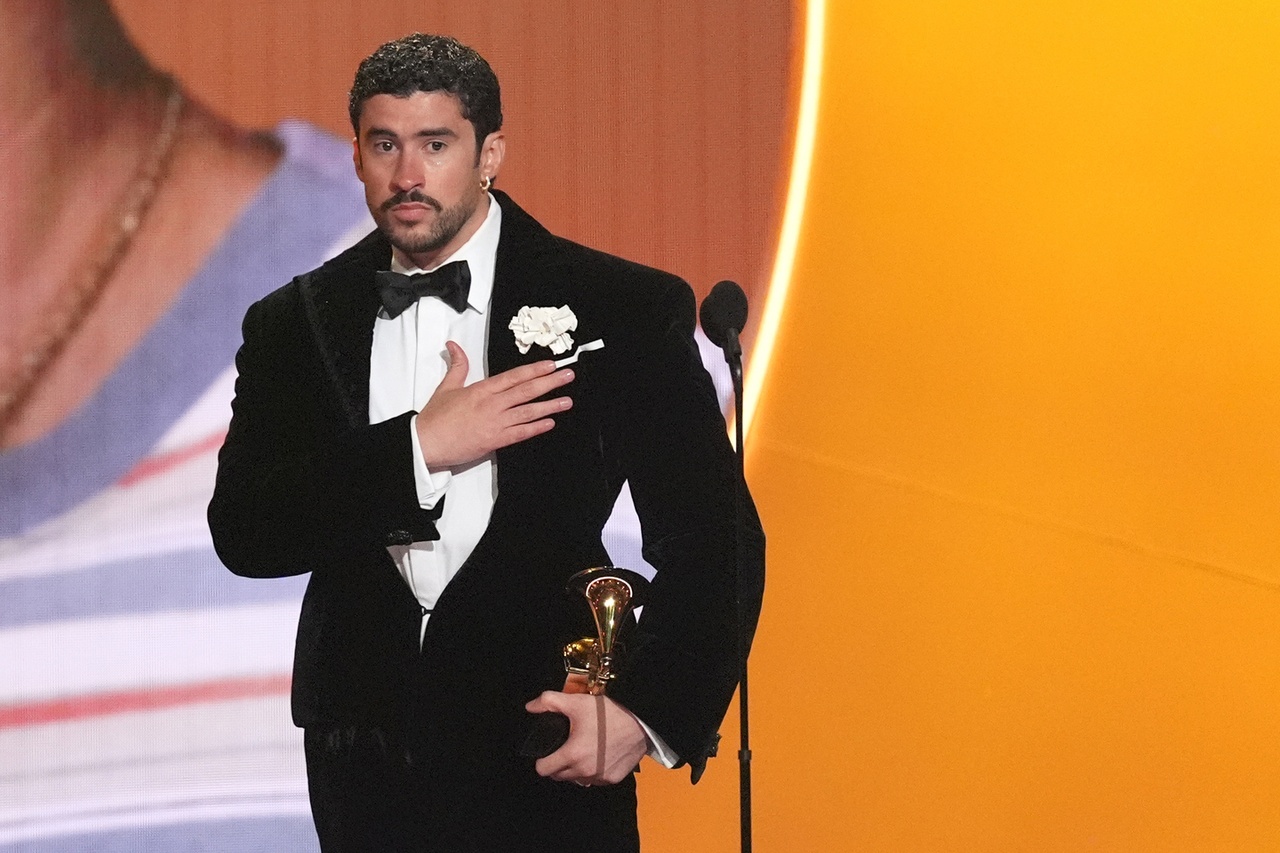
The ceremony, which ran for about three hours, concluded with Album of the Year going to Puerto Rican artist Bad Bunny for his sixth studio album, “Debí Tirar Más Fotos” (2025). It marked the first time a Spanish-language album had won that category.
Accepting the award in both Spanish and English, Bad Bunny said, “Puerto Rico, believe me when I say that we are so much bigger than 100 by 35 [miles], and there is nothing that exists that we can’t accomplish,” referring to the island’s size.
“I want to dedicate this award to all the people who had to leave their homeland, their country, to follow their dreams,” he said.
Song of the Year went to Billie Eilish’s “Wildflower” (2025), while Record of the Year was awarded to Kendrick Lamar and SZA’s duet “Luther” (2024).
This article was originally written in Korean and translated by a bilingual reporter with the help of generative AI tools. It was then edited by a native English-speaking editor. All AI-assisted translations are reviewed and refined by our newsroom.
BY CHOI MIN-JI, JEONG EUN-HYE, CHOI HYE-RI [shin.minhee@joongang.co.kr]