Oscar! 'KPop Demon Hunters' completes epic awards run with original song, animated film wins.
“KPop Demon Hunters” (2025) claimed a double victory at the Academy Awards, completing a triple crown after accolades at the Golden Globes and the Grammys. The film won Best Animated Feature Film and Best Original Song at the 98th Academy Awards held Sunday at the Dolby Theatre in Los Angeles.
Along with its success at the Golden Globes this year, its newest trophies means that the film notched double wins at the United States' two most important film awards in the span of a few months. In addition, earlier this year the film’s theme song “Golden” (2025) also became the first K-pop song to win a Grammy Award.
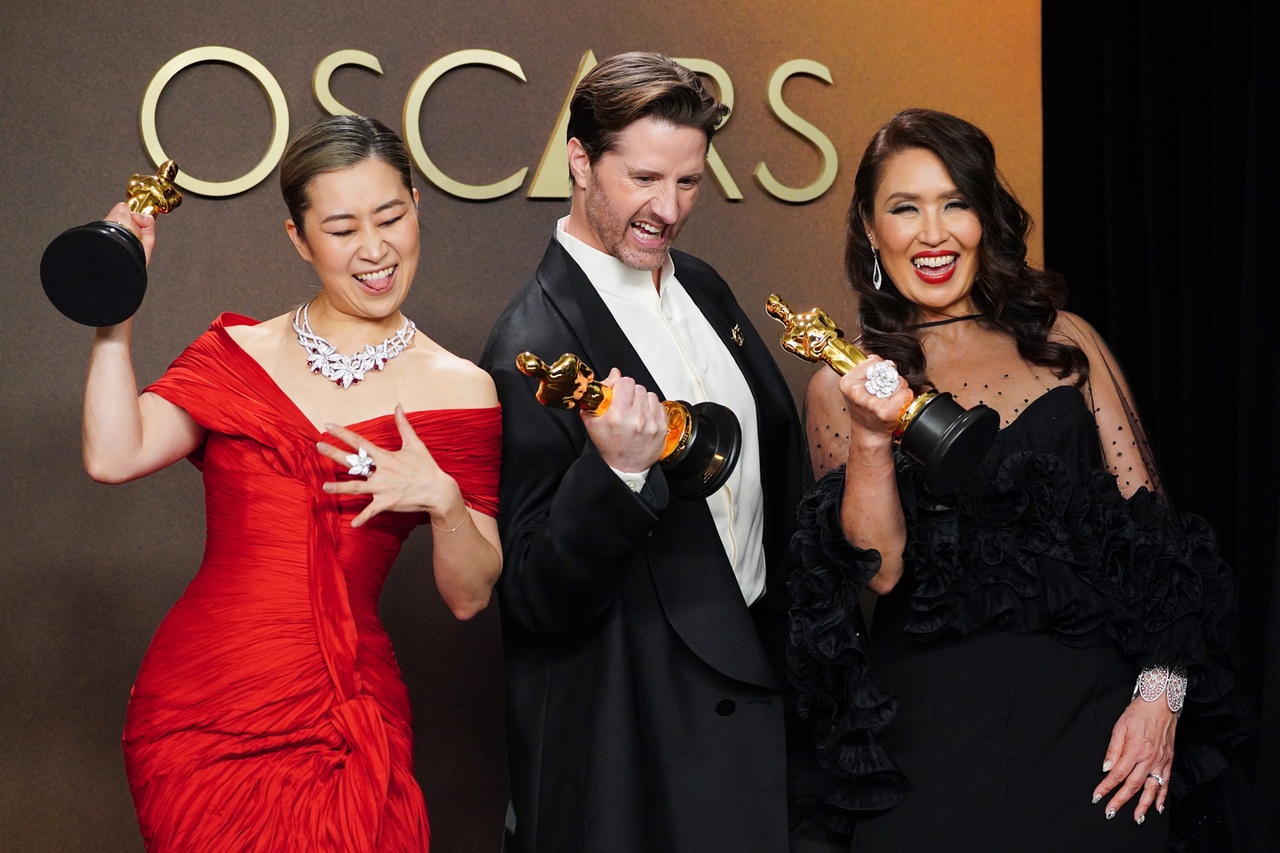
“To all the fans who got us here and for all of those who look like me, I am so sorry that it took us so long to see us in a movie like this,” said director Maggie Kang said after winning Best Animated Feature Film. “But it is here, and that means that the next generations don't have to go longing. This is for Korea and for Koreans everywhere.”
Chris Appelhans, who stood onstage with her, and producer Michelle Wong also offered words of thanks.
“KPop Demon Hunters” tells the story of HUNTR/X, a demon-hunting K-pop idol group that defeats evil spirits and protects the world through song.
“Growing up, people made fun of me for liking K-pop, but now everyone is singing our songs and all the Korean lyrics,” said singer EJAE, who voices a member of HUNTR/X and who performed during the ceremony. “I'm so proud and I realize that the song this award is about not about success but it's about resilience.”
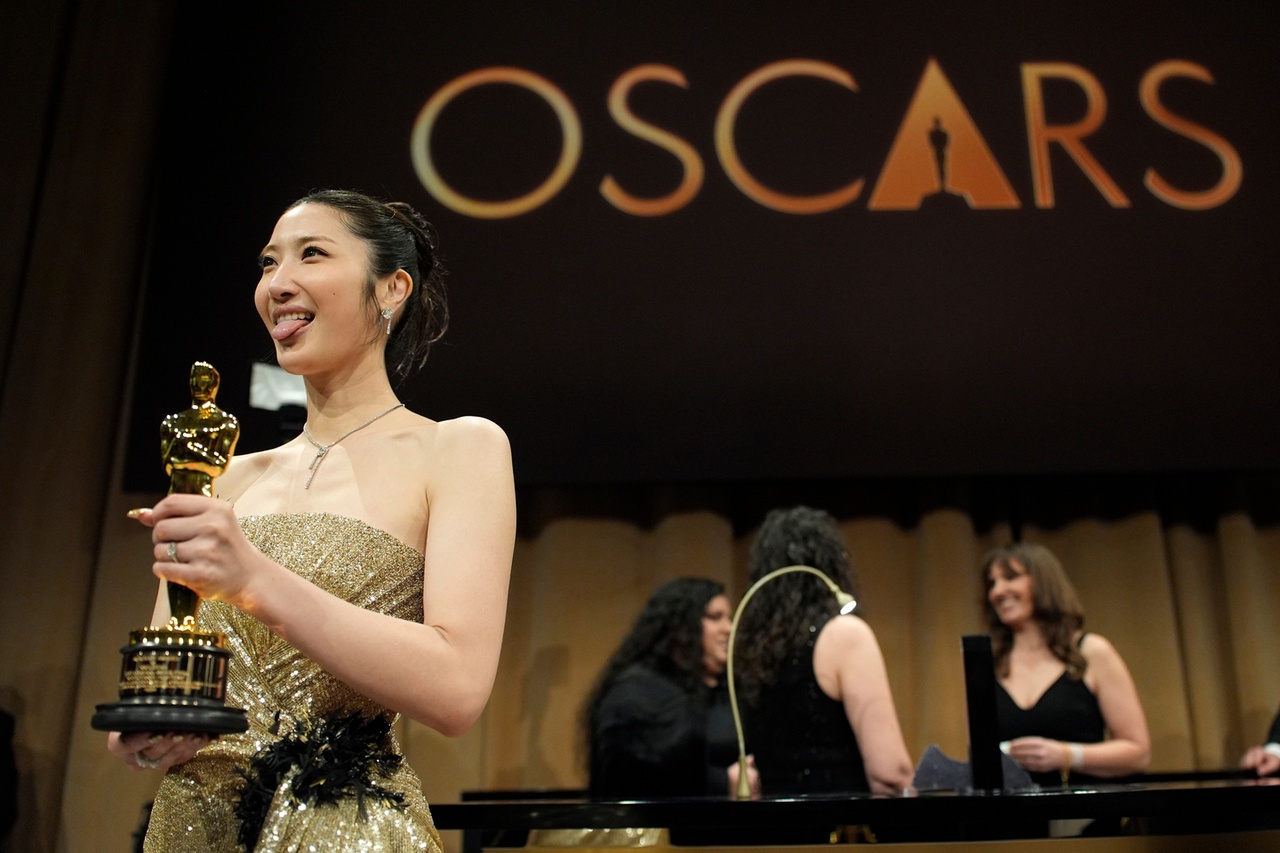
The song’s seven credited cowriters are EJAE, Teddy Park, 24, the trio IDO — Lee Yu-han, Kwak Joong-gyu and Nam Hee-dong — and U.S. lyricist and composer Mark Sonnenblick. It marked the first Academy Award win for Korean and Korean American musicians.
Although production and distribution were handled by U.S. companies including Sony Pictures Animation and Netflix, the film is widely regarded as K-content in all but name because its story is built around K-pop and traditional Korean culture, with major participation from Korean Americans and K-pop artists.
In the film, the HUNTR/X members enjoy cup ramyeon (instant noodles sold in cups), gimbap (rice rolls wrapped in seaweed) and gukbap (a Korean soup served with rice), while Korean folk elements such as dokkaebi (goblin-like supernatural beings) and dangsan trees (village guardian trees associated with folk beliefs) also appear. The Associated Press said the wins once again showed the global influence of Korean popular culture.
“‘KPop Demon Hunters’ winning was expected, but the ‘Golden’ stage was surprising,” film critic Min Yong-jun said. “To hear pansori [a traditional Korean genre of musical storytelling] and see a performance by dancers in hanbok [traditional Korean clothing] based on traditional Korean dress on the Oscar stage was a symbolic sign that a regional culture called K-culture has leapt to a global level.”
The ceremony also featured congratulatory performances of “Golden,” a nominee for Best Original Song, and “I Lied To You” (2025), the theme from “Sinners” (2025). The Oscars have usually staged performances of all five Best Original Song nominees, but this year organizers allowed only two because of time constraints. The “I Lied To You” performance came ahead of the presentation of Best Supporting Actress in the first part of the show.
U.S. singers Miles Caton and Raphael Saadiq sang the blues amid thick smoke on a stage designed as a shabby New Orleans bar from the 1930s, the setting of the film.
The “Golden” stage appeared in the third part of the ceremony, just before the presentation of Best Original Song and ahead of major awards including Best Picture and Best Actress and Actor in a Leading Role.
The performance opened with “Hunters Mantra” (2025) from the “KPop Demon Hunters” soundtrack in a rich pansori style, followed by a 24-person ensemble of percussionists, grim reapers and dancers creating a stage that blended Korean shamanistic ritual and mask dance.
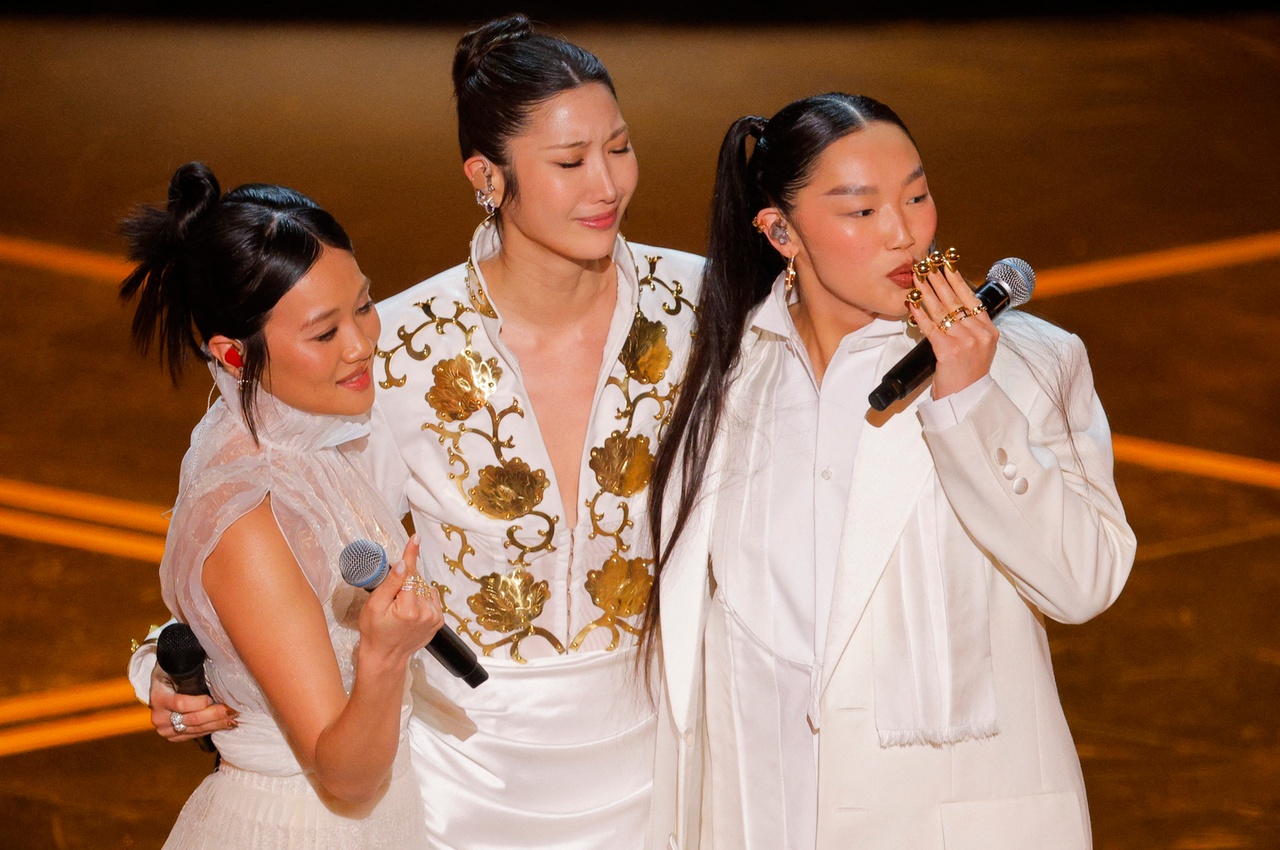
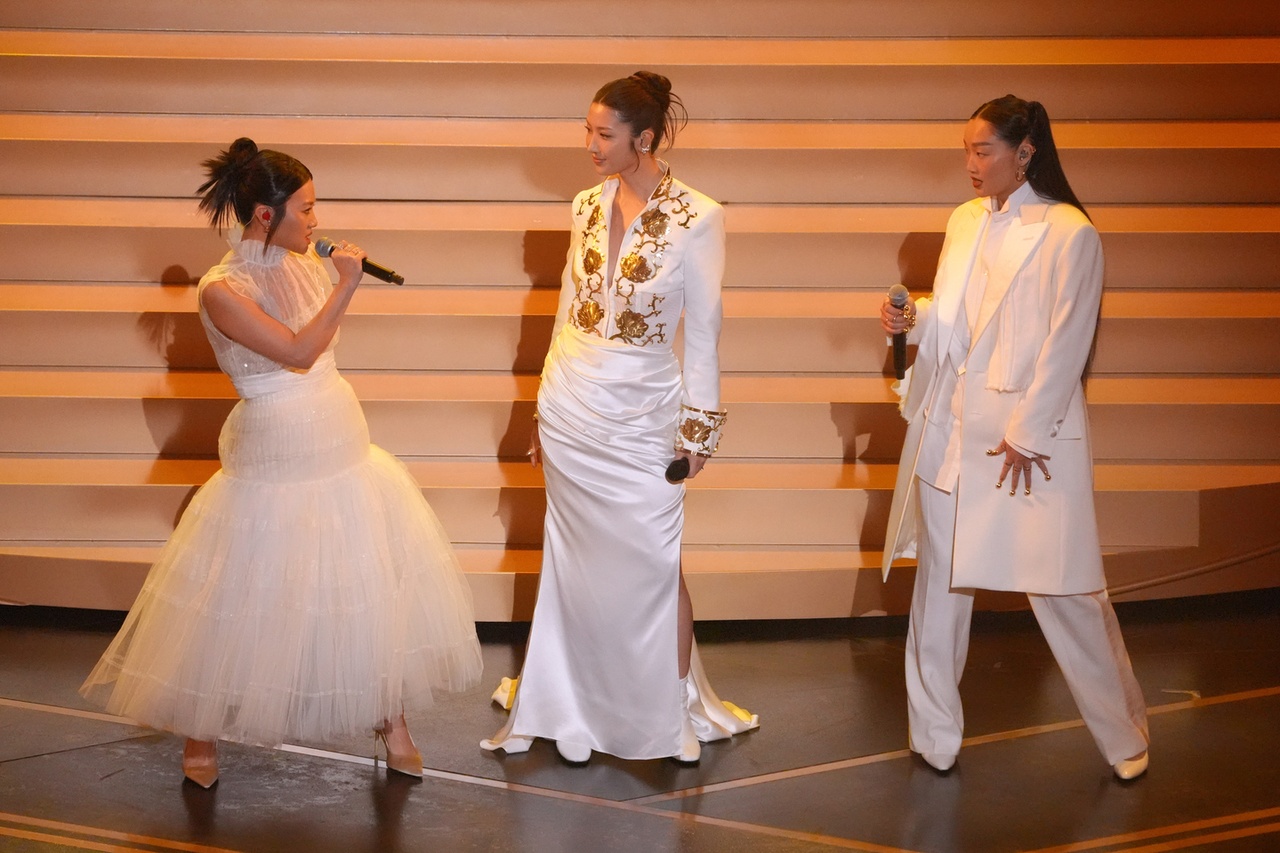
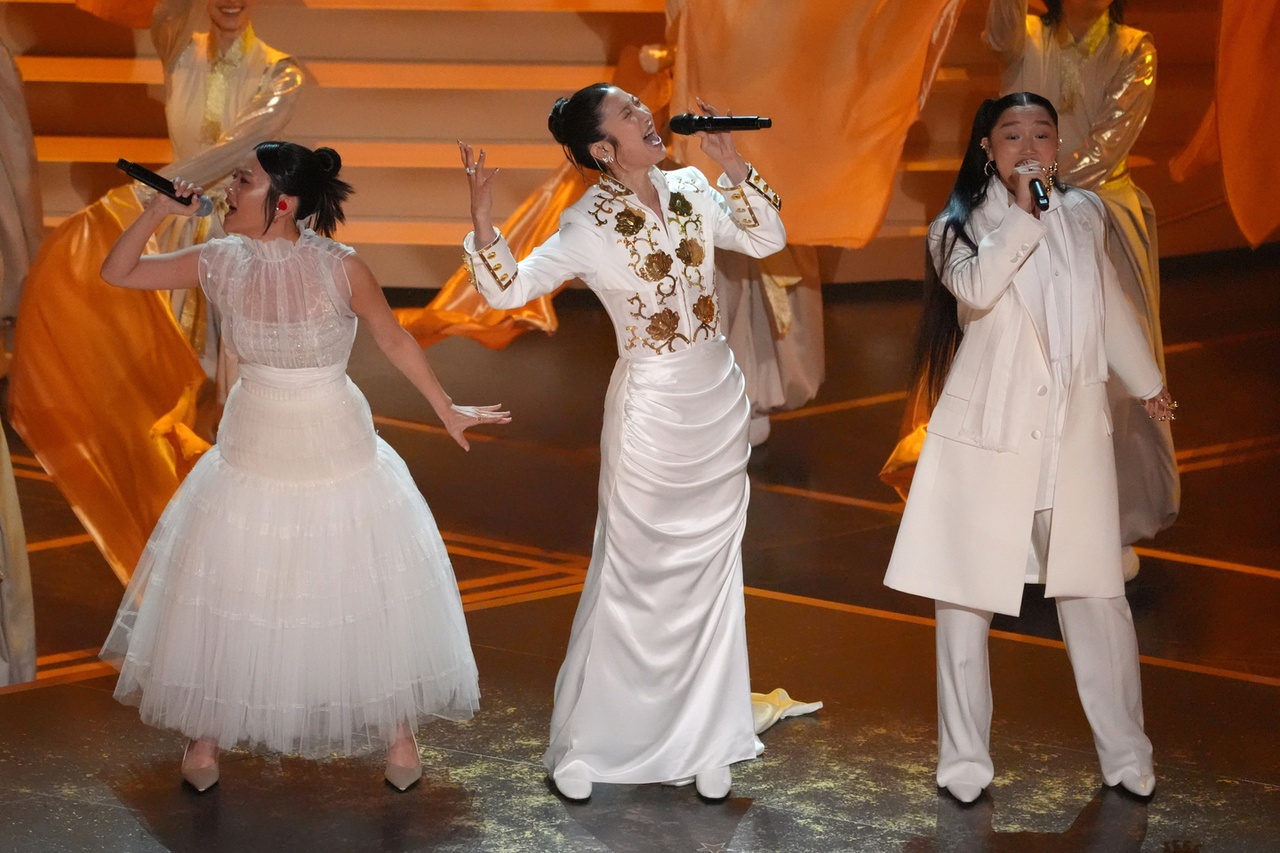
EJAE, Audrey Nuna and Rei Ami, who provided the singing voices for the girl group HUNTR/X in the film, then appeared in white stage outfits trimmed in gold, belting out “Golden.” Behind them, 24 dancers performed in formation with gold flags, creating a striking spectacle.
The broadcast also showed Hollywood stars including Leonardo DiCaprio enjoying the performance from the audience while waving light sticks — symbolic of K-pop cheering culture.
“A big thing about these performances this year is you’re not just celebrating the songs. You’re celebrating the film,” Mandy Moore, the creative director of the stage, told The Associated Press. The gold flags onstage and the light sticks in the audience also came from Moore’s idea.
“Traditional Korean music came in at the beginning of the performance, and that made me especially proud,” EJAE told Netflix. “It felt like we were able to truly connect with our roots.”
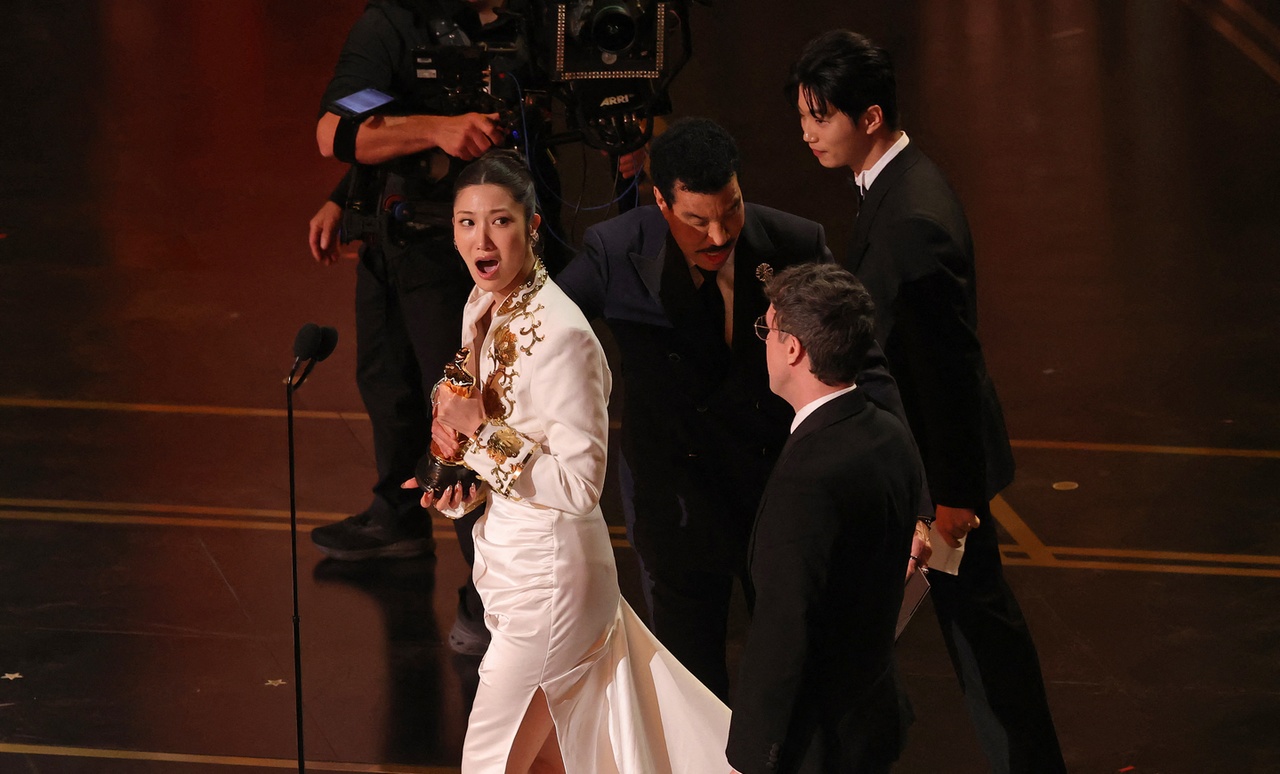
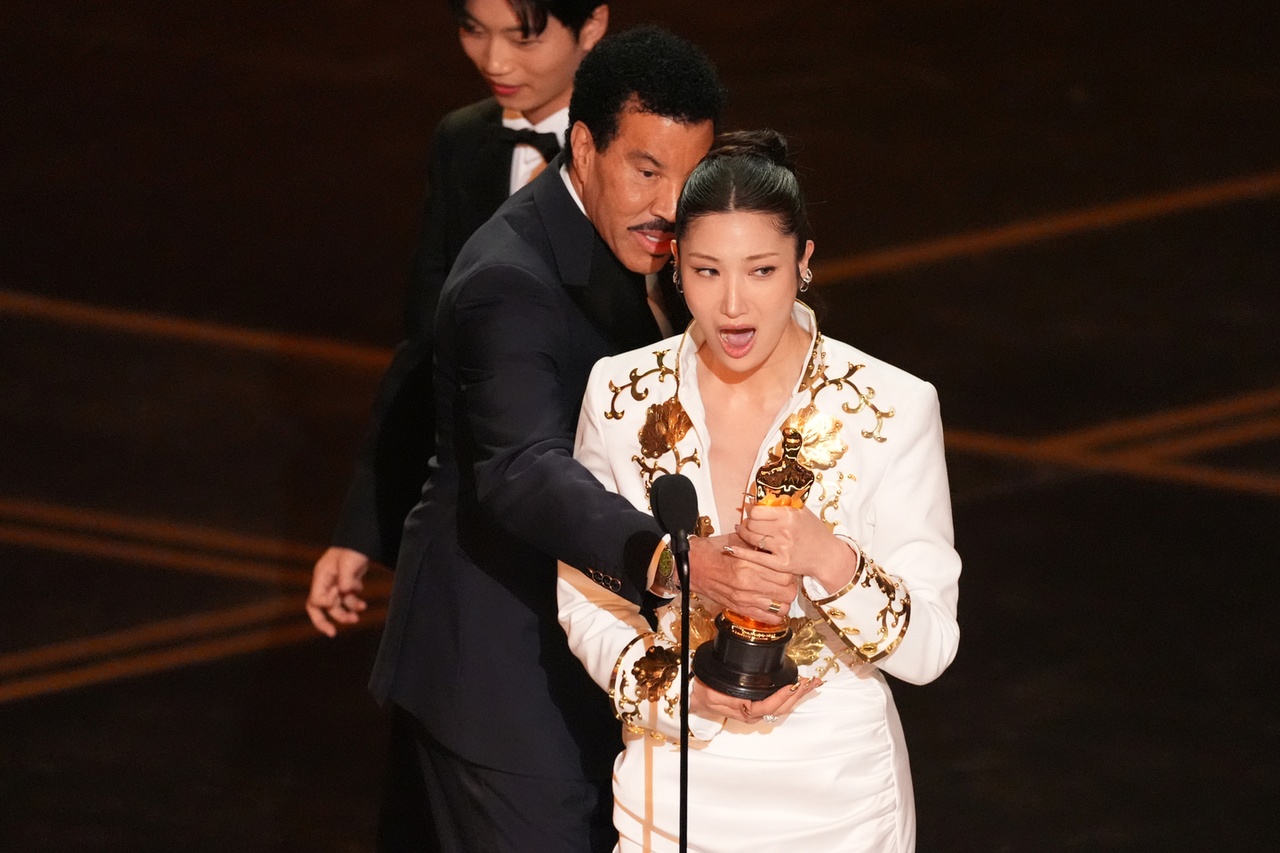
But the presentation that followed the festival-like performance was not as smooth. Right after EJAE finished her remarks and handed the microphone to Lee Yu-han, the acceptance speech was cut off. As soon as Lee began to speak, music urging the winners off the stage started to play. EJAE and Sonnenblick asked for more time, but the camera zoomed out.
Acceptance speeches have often been cut short at the Oscars, but there was criticism that the “KPop Demon Hunters” winners were treated especially harshly that night. Earlier, even during the Best Animated Feature Film acceptance speech, music began to play as Wong tried to speak.
“Expect K-pop fans to riot on social media because it was a moment, and could have been an even bigger one had they been given more time,” said CNN. “For shame.”
Since the category was first introduced in 2002, the Academy Award for Best Animated Feature Film has been dominated by Disney and Pixar. Of the 23 ceremonies held through last year, Disney and Pixar films won 15 times.
Wins in the category for animated films drawing on non-Anglophone cultures have been relatively rare. Notable examples include Hayao Miyazaki’s “Spirited Away” (2001) and “The Boy and the Heron” (2023), Guillermo del Toro’s “Guillermo del Toro’s Pinocchio” (2022) and “Flow” (2024), a Latvian film made with French and Belgian coproduction partners.
“‘KPop Demon Hunters’ is a work that captured not only the kind of cultural diversity the Academy wants, but also overwhelming popular appeal,” said Han Chang-wan, a professor of animation at Sejong University. “It is a highly meaningful achievement.”
This article was originally written in Korean and translated by a bilingual reporter with the help of generative AI tools. It was then edited by a native English-speaking editor. All AI-assisted translations are reviewed and refined by our newsroom.
BY JEONG EUN-HYE, CHOI HYE-RI [kim.minyoung5@joongang.co.kr]